



Preparing for your first SOC (System and Organization Controls) 2 examination involves understanding whether your security controls, policies, and supporting evidence are ready for review. A SOC 2 readiness assessment examines these areas to identify gaps, clarify documentation needs, and establish practical steps before an independent examination. It helps you understand what is already working and what may require additional attention.
Your organization may already have security practices in place without having the records needed to demonstrate how they operate. Reviewing your controls and supporting documentation early can help you organize responsibilities, address weaknesses, and make informed decisions about your examination timeline.
At ElevaTec Solutions Consulting, LLC, we understand that preparing for SOC 2 can involve coordinating several teams, reviewing existing processes, and gathering evidence from different systems. We help organizations examine their current practices, identify areas requiring improvement, and organize readiness priorities based on their operating environment.
If you’re evaluating your organization’s preparation, you can explore our SOC 2 readiness consulting services to learn how a structured review can help you identify gaps and plan your next steps.
Why Is a SOC 2 Readiness Assessment Important?
A readiness assessment helps you determine whether your security practices and supporting records align with the requirements relevant to your planned SOC 2 examination.
SOC 2 examinations use Trust Services Criteria established by the AICPA (American Institute of Certified Public Accountants). These criteria address five categories: security, availability, processing integrity, confidentiality, and privacy. Security is included in SOC 2 examinations, while the other categories are selected according to the organization’s examination scope.
An important distinction is that a readiness assessment is not the independent SOC 2 examination itself. Readiness consulting focuses on preparation, while a qualified independent CPA (Certified Public Accountant) firm performs the formal examination and issues the SOC 2 report.
Understanding this difference helps you plan the necessary preparation before engaging an independent examiner.
What Does a SOC 2 Readiness Assessment Cover?
A typical readiness assessment examines your existing security controls, supporting evidence, and documentation practices. The exact scope depends on your systems, business processes, and applicable Trust Services Criteria.
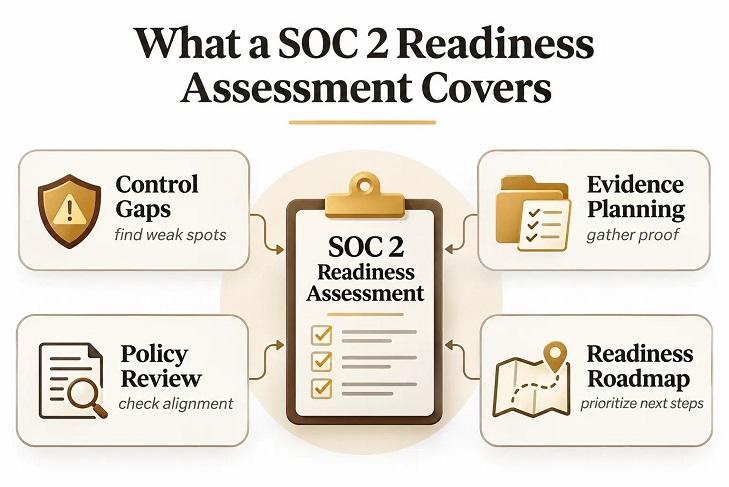
Four important components help establish a clearer picture of your organization’s readiness.
1. Control Gap Identification
Security controls are measures your organization uses to manage risks, such as restricting system access, monitoring activity, and responding to security incidents.
During a readiness assessment, existing controls are reviewed against applicable SOC 2 criteria to identify areas that may require improvement.
For example, your organization might have procedures for granting employee access but lack a consistent process for reviewing whether that access remains appropriate.
Identifying these gaps helps you prioritize improvements before the independent examination.
2. Evidence Planning
Having security controls in place is only part of SOC 2 preparation. You also need supporting evidence that demonstrates how relevant controls operate.
Depending on the assessment scope, examples may include:
- Records of employee access reviews and approvals.
- Security awareness training records.
- Documentation of incident response activities.
Evidence planning helps identify which records are needed, where they are maintained, and who is responsible for collecting them.
This process is particularly useful when evidence is spread across different departments or systems.
3. Policy and Documentation Review
Written policies help explain how your organization manages security responsibilities and expectations. However, policies should also reflect what your teams actually do.
A readiness assessment may examine information security policies, access management procedures, and incident response documentation for completeness and consistency.
For example, a policy might require regular security reviews, but the organization may not have maintained records showing those reviews occurred.
Examining documentation alongside actual practices helps identify inconsistencies that should be addressed before the examination.
4. Readiness Roadmap
Once potential gaps are identified, a readiness roadmap helps organize the work that remains.
A roadmap may address:
- Security controls requiring clarification or improvement.
- Documentation and evidence that need additional attention.
- Internal responsibilities and priorities for completing preparation activities.
The goal is to create practical next steps based on your organization’s current circumstances rather than treating every identified issue as equally urgent.
How Does the Readiness Assessment Process Work?
Although the approach varies depending on your organization, a readiness assessment generally follows a structured sequence.
Step 1: Define the assessment scope. Identify the systems, business processes, and applicable Trust Services Criteria relevant to the planned examination.
Step 2: Review existing practices. Examine current security controls, policies, procedures, and available evidence to understand what is already established.
Step 3: Identify and prioritize gaps. Determine which areas need attention and organize recommendations according to their relevance and importance.
This process may involve people responsible for information technology, security, operations, and compliance. Their involvement helps connect documented procedures with everyday business activities.
At ElevaTec Solutions Consulting, LLC, we provide cybersecurity GRC consulting services that support organizations addressing security controls, risk management, and compliance preparation. Our approach focuses on helping your team understand existing practices and determine where additional work may be needed.
What Should You Expect After the Assessment?
After a readiness assessment, you should have a clearer understanding of your organization’s current preparation and the activities that may still require attention.
Depending on the engagement, the findings may help you:
- Understand which controls and documentation need improvement.
- Identify missing evidence and clarify collection responsibilities.
- Establish priorities for addressing gaps before the examination.
These findings can also support discussions with internal stakeholders about available resources and preparation timelines.
A readiness assessment does not guarantee a particular SOC 2 examination result. Its value comes from helping your organization make better-informed preparation decisions.
When Should You Consider a Readiness Assessment?
A readiness assessment can be useful when your organization is preparing for its first SOC 2 examination, responding to customer security expectations, or reviewing controls after operational changes.
You may also benefit from a structured review when documentation has not kept pace with business growth or responsibilities are shared across multiple teams.
The timing and scope of an assessment depend on your existing controls, documentation, internal resources, and examination goals. Reviewing these factors can help you determine when additional guidance may be useful and which preparation activities deserve attention.
At ElevaTec Solutions Consulting, LLC, we support organizations across industries such as healthcare, financial services, SaaS (Software as a Service), and technology, as well as small and mid-sized businesses. We understand that your security responsibilities, existing controls, and compliance priorities depend on your business environment. Our consulting approach considers these differences when helping you identify readiness needs and practical next steps.
Prepare for Your SOC 2 Examination With Clear Next Steps
Understanding your readiness begins with reviewing the controls you already have, identifying evidence gaps, and determining what needs improvement. A structured assessment helps connect these findings to practical preparation activities.
Addressing these areas before the independent examination can help your team approach the process with clearer responsibilities and a better understanding of outstanding work.
If you’re preparing for a SOC 2 examination and would like guidance on your current controls, documentation, or evidence requirements, you can book a consultation to discuss your readiness concerns and explore how our consulting services can support your preparation.